
The Ultimate Guide to Dust-Mite Proofing Your Home
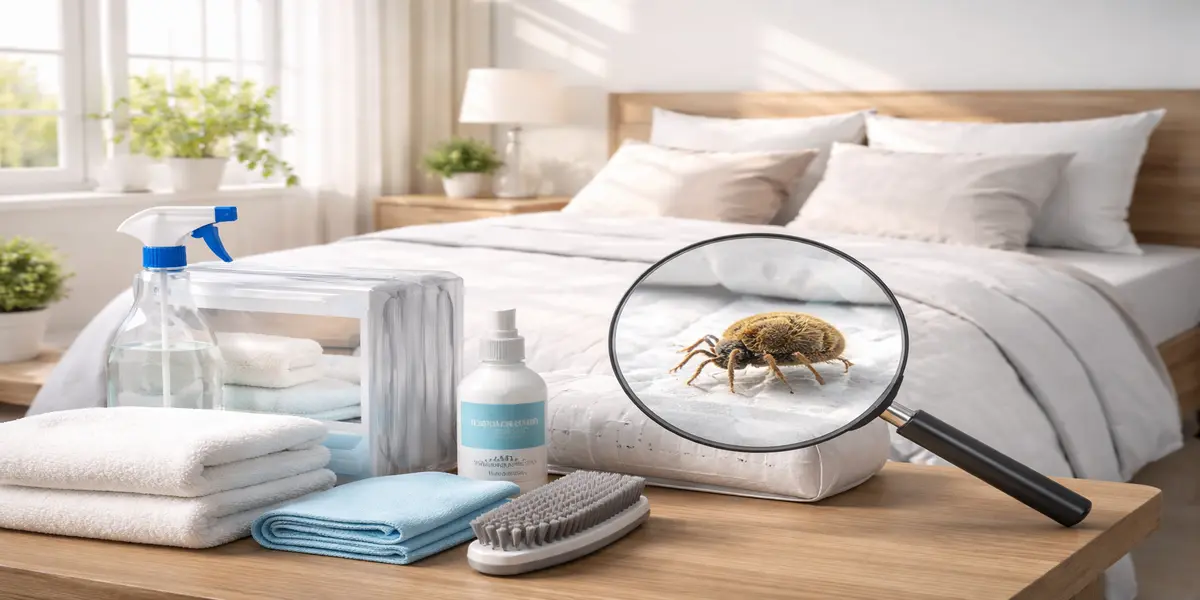
Did you ever wake up with a sore head and scratching eyes, and no idea whether you were really alone in your own bed? It is a shocking truth, yet to millions of individuals, the most constant of the monsters at home are not those that are microscopic, but those that are living right in their mattresses and pillows. These unseen housemates are called dust mites and live where we feel most at home making our safe havens the breeding ground of allergens. Although they do not bite or sting, their presence is experienced in the form of chronic sniffles, cough, and sleepless nights they bring.
It is not only a question of cleanliness and reclaiming your home with these microscopic invaders but rather a matter of knowing their biology and how to destroy the environment they need to survive which is to make your living place a breathable and allergy free environment.
1. The Dust Mite: The Microscopic World
Dust mites are tiny, arachnids that are eight legged, thus distant relatives of spiders and ticks, as per cleaning professionals. They are much too minute to be detected with the naked eye, but they are present by millions in the ordinary house dust. They feed mainly on dander, the minute flakes of human and animal skin that are shed each day by humans and pets.
The mites themselves are not the true cause of allergies, but a particular protein present in the mite waste and body parts that have been broken down. Once such microscopic particles are aerosolized, as is usual when performing such simple tasks as fluffing a pillow or walking over a rug, they are readily inhaled, causing an immune response in the susceptible. For a more thorough removal of deep-seated dust and allergens, professional end of lease cleaning services can be highly effective.
2. The Bedding Barrier should be Fortified
As the bedroom is the most susceptible area of dust mite activity, your initial defence should be based on your mattress and pillows. Normal fabric weaves are porous enough to allow mites to crawl through with little effort, and essentially let your mattress act as a giant sponge to allergens throughout the years.
Along with the use of barriers, your laundry routine is an important part of population control. Washing your sheets in cold or lukewarm water will help to eliminate a little dust but it will not kill the live mites in the fibers. You need to wash all sheets, pillowcases and blankets at least once a week to actually sanitize your bedding in water no less than 60o C. In cases where the item is not washable, a fifteen-minute high-heat dryer can also work to de-mite the item.
3. Drying up the Enemy by Keeping the Humidity Down
Among the most intriguing and exploitative facts about dust mites are the fact that they do not consume liquid water. Rather, they take moisture directly through the air using their shells. It implies that they can only survive under the condition of the humidity of your residence. When the air is made to be too dry, the mites will ultimately dry up and perish due to lack of their internal fluid homeostasis. This biological peculiarity gives you a great, chemical-free means of controlling their numbers.
When you maintain a relative humidity in your home at a consistently low level (below 50 percent) with the help of a dehumidifier, you are providing a natural environment that dust mites do not like. This can be checked by just keeping a simple hygrometer to know when your home is approaching the danger zone to grow mites. This plan is especially significant in the basement, laundry and bedroom areas where the moisture will be accumulated. The mites are unable to reproduce when the air is kept dry and the population that has been formed will quickly reduce. To further improve indoor air quality and reduce allergen circulation, you can also learn how to clean air ducts safely and efficiently.
4. Strategic Flooring and Surface Management
Dust mites can be found at the end of existence in soft surfaces since they build up skin cells and moisture within the fibers. Wall-to-wall carpeting is probably the greatest culprit in the home since even the strongest vacuum cleaners cannot penetrate deep to the bottom of the carpet pile where mites reproduce and leave their rubbish. To achieve much relief in the case of allergy, the best long-term approach is to substitute carpets with hard-flooring such as hardwood, tile, laminate, or vinyl flooring. Such surfaces are far simpler to clean out and do not offer the nesting habitat that the mites desire.
When it is not possible to remove carpet, then you have to turn your attention towards high-intensity maintenance. This involves the use of small rugs that can be washed in the machine using high temperatures and furniture with smooth surface instead of heavy upholstered furniture. In the case of curtains, it is advisable to substitute heavy and dust-laden drapes with easy-to-clean blinds or lightwoven, washable fabrics.
Conclusion
The goal of getting permanent relief against dust mite allergies is not to build a sterile laboratory like environment, but rather to maintain the same control of the allergens you have to contend with as a regular part of your body. Through bedding, humidity in your air, and improvement of your expert cleaning equipment, you can disrupt the reproduction and growth of the mite. These invisible guests might never be completely gone, but these measures will make sure that they will no longer have a say in how you will sleep or how well you will be.
Related Posts

10 Powerful Cleaning Tricks or Hacks Using Soda Crystals
Have you ever wondered how half the number of cleaners in your cupboard can be…
How to Clean Air Ducts Safely and Efficiently?
What was the last time you considered whatever is going through your air ducts and…

Ultimate Guide For Pleasant Scent in Your Bathroom Area
Bathrooms are the most frequented spaces in any house, so it is hard to maintain…